Rhythms of Sky, Sea and Land
Rhythms of Sky, Sea and Land: the Orchestra of Sound and Light and the South Downs Songbook
Homepage for the Orchestra of Sound and Light’s website: https://www.educationmusicprojects.com/
It is 10 years since Orchestra of Sound and Light started, co-founded by me and music and arts events producer, Liz Webb. Orchestra of Sound and Light is a Sussex based ensemble drawing on top professional musicians from the region who have a love of teaching and communication. The band is all about excellence and joyful participation by all.
The South Downs Songbook is one of our six signature projects, all featured on our new website. All of our projects can be hired and reshaped for new settings, just get in touch (contact info on the website).
South Downs Songbook is about developing and celebrating composers today through songs and compositions shaped by imaginative interaction with the South Downs, and particularly through the experience of people as they walk the landscape. And I mean people who live today, and who lived centuries ago. Through this project all the participants discovered rich veins of poetry and song about walking and living in the South Downs.
The South Downs is a region intersected by sea, sky and landscape. It is a place where people live, walk, and journey to and from, and hold in their memory, which is why it is sometimes a focus for bigger themes about culture and the state of the nation.
We know that its aesthetic qualities are also fascinating. Patterns of landscape, and movements of clouds and sea, have preoccupied and influenced artists for centuries (for example, Eric Ravilious, Claude Debussy, Charlotte Smith).
Because musicians work in a time-based art form, the rhythms of walking and journeying, their beats and patterns, and music's special ability to 'draw' shapes (verticals, horizontals, contours, aerial and ground perspectives) became a particular focus in this project.
However, Orchestra of Sound and Light's projects are always interdisciplinary. This is because from the beginning we were excited by mixing music and film together to produce new effects and sensations that excited young people. Mixing these brilliant artforms together made them more accessible to students through their own creative work. To the South Downs Songbook project we added poetry and choreography as well as moving images and song-writing. So the rhythms, motions, beats, patterns and sensations of music work in combination and counterpoint with other arts, beating out the patterns of our landscape.
While reflecting on the OSL and the South Downs Songbook for a presentation at Prof Margaretta Jolly's conference 'Sussex Retold: Sounds, Sites and Stories’, I realised that the origins of this project are in lockdown. In 2020 and 2021, during periods when making music together was incredibly constrained except in very specialised conditions (recalling recording sessions with musicians placed 2m apart!), I developed two geolocated soundwalks, using the Echoes app, and in partnership with South Downs National Park Authority (2020), and then Ditching Museum of Art + Craft and Brighton Festival (2021). Working on these projects made me realise we could produce distinctive visions of what it is like to live today in an extraordinary place, through a combination of music, visual art and actually walking in and through the landscape.
Coming out of lockdown, it seemed natural to develop this further through commissioning contemporary songs, especially with the awareness of rich traditions of writing, poetry and song that that the region holds.
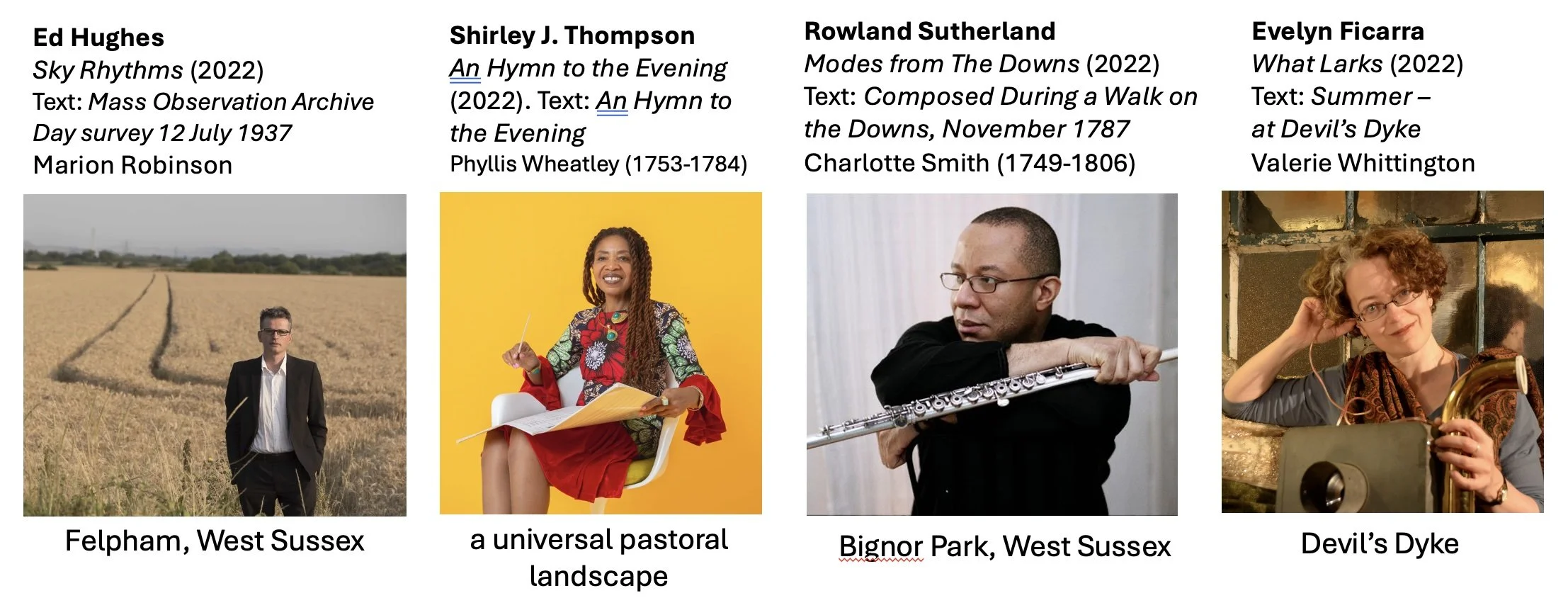
Four composers commissioned for the South Downs Songbook (2022) by Orchestra of Sound and Light
In 2022 OSL commissioned four British composers, with different backgrounds, interests and styles. Each composer was asked to write a five-minute song for solo voice and ensemble. The solo voice in our project is the mezzo Rachel Farago, a University of Sussex music graduate, who is now an internationally recognised singer and voice performer. Rachel's work interestingly transcends classical and pop vocal settings. This was perfect for the approach I had in mind. Similarly I wanted a band that connected classical and contemporary worlds - so we have flute, clarinet, cello, and keyboards including synth and sampler, and electric guitar with pedals. Yes, it's an adaptation of the 'Pierrot' line-up.
The texts for the four songs are from different times, but each are strongly connected to place:
Ed Hughes - text from the Mass Observation Archive 12 July 1937 by Marion Robinson, resident of Felpham
Shirley J Thompson - poem by Phyllis Wheatley (1753-1784), evoking the universal ultimate experience of sunset and darkness over natural landscapes and the feelings this brings
Rowland Sutherland - poem by Charlotte Smith (1787), exploring walking the downs at Bignor Park in West Sussex
Evelyn Ficarra - poem by Valerie Whittington (2022), on the Devil's Dyke in summer with sounds of skylarks
The approach of each composer is very different, as can be heard in this brief video sampler of extracts from each song (from the live premiere at the Attenborough Centre for Creative Arts at University of Sussex):
Ed Hughes - song moves from a spiky rhythmic style to a reflective lyrical mode influenced by folksong, matching the shift in Marion's text from everyday concerns to the transcendent impact of witnessing skyscapes over the South Downs in West Sussex
Shirley J Thompson - song embodies the pace and rhythm of walking through pattern making and an operatic lyricism that embraces the ecstatic and religious feelings of Phyllis Wheatley's poem
Rowland Sutherland - brings his unique blend of classical, hip-hop and Latin Jazz to produce a uniquely evocative response to Charlotte Smith's poem about walking one day in West Sussex
Evelyn Ficarra - applies fragmentation to Valerie Whittington's poem and to the samples of bird song to produce ground and aerial visions of flight and the precarity of nature
The four composers' different styles are unified by their love of walking, landscape and exploring the human experience of nature which we share with birds and other creatures that populate the South Downs.
In 2022 we attached a significant education project to the new commissions from the four professional composers. We performed the new songs to students in sixth form colleges across Sussex. Then we mentored the students to produce their own songs and compositions. This added immeasurably to a rich and exciting collection. In 2024 we built on this further, in our follow-on project 'From Felpham to Beachy Head'. Working this time with a single poem, Charlotte Smith's Beachy Head, the voices of year 9 and year 10 students at schools across West and East Sussex became our central focus, this time incorporating dance, music, movement, photography and film into performances of sets unified by remarkable 'journeys' formed of highly diverse readings through Smith's epic poem.
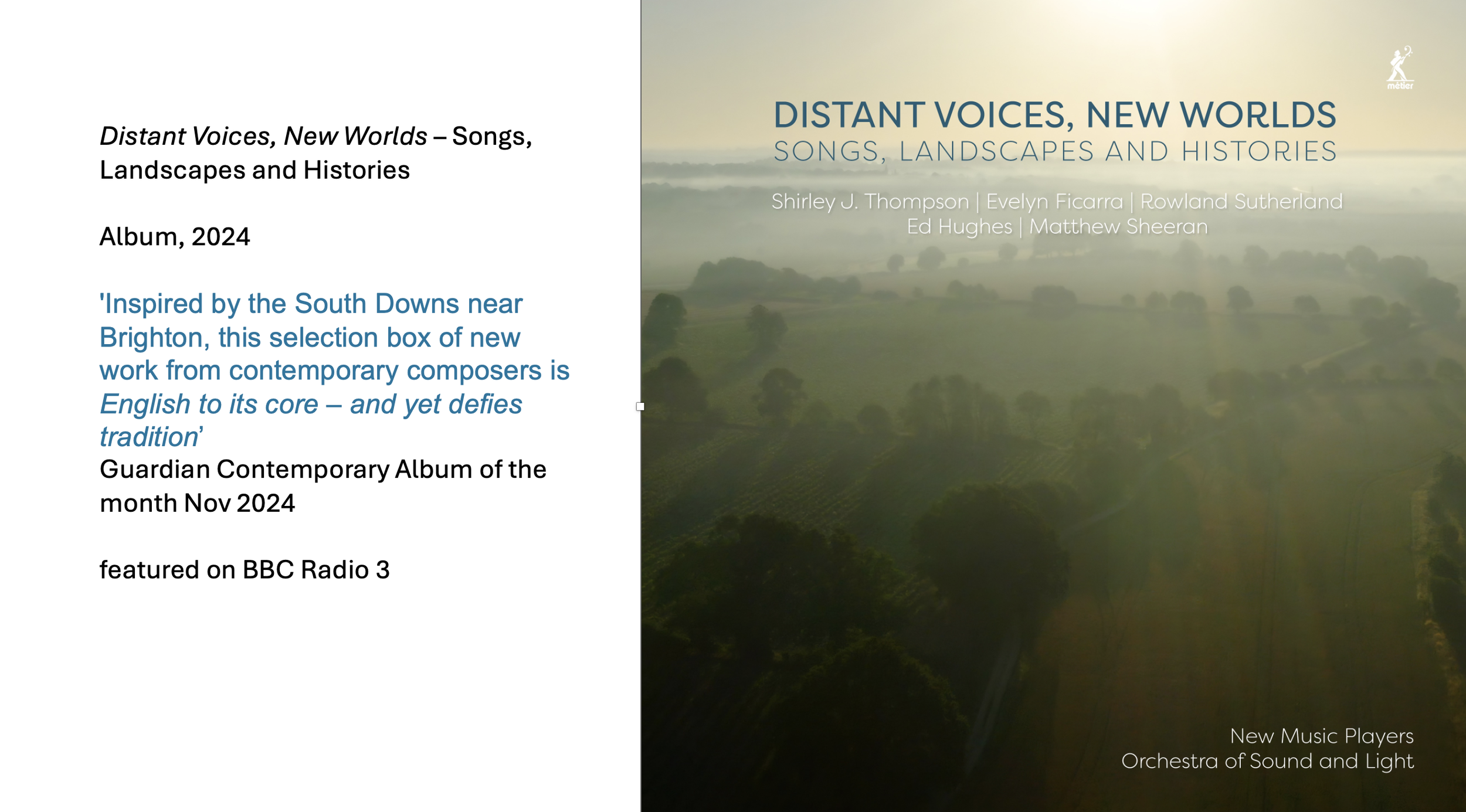
We gained recognition! Our South Downs Songbook project album 'Distant Voices - Songs, Landscapes and Histories' was a contemporary album of the month for the Guardian, who wrote that the album was 'English to its core - and yet defies tradition'. Tracks from the album were featured on Night Waves (BBC Radio 3). The album is available.
The process of developing the South Downs Songbook has itself been a big journey. I was particularly touched by the way the student dance work capped an expansion from music to film to poetry to song to choreography - all exploring different aspects of rhythm, line, light and movement as metaphors for landscape and memory.
In retrospect, it seems there was also a journey undertaken from individual human experience of the South Downs to the significance of our shared occupation of this strange and hypnotic landscape, and then finally to the powerful social themes provoked by Beachy Head and raised in Charlotte Smith's work. Thus we have ended up with a powerfully rich and diverse songbook, ranging across professional and student artists, and speaking equally to individual experience and to shared themes (borders, conflict, environmental beauty, precarity and despoliation) that are voiced in Smith's work and occupy and challenge us today.
EH 19.6.2026
Thank you to the Arts Council England for support for the Orchestra of Sound and Light, via its Grant for the Arts scheme; the Brighton Dome and Brighton Festival, the South Downs National Park Authority, and the Towner Gallery, for partnering with Orchestra of Sound and Light to produce these projects, and the University of Sussex (Faculty of Media, Arts and Humanities) for time and financial support.
Credits and thanks to:
Schools and Colleges (2022): Hastings Academy, BHASVIC, East Sussex Academy of Music
Schools and colleges (2025): Felpham Academy, Ifield Community College Crawley, Varndean School, Ratton School
Musicians (2024) Rachel Farago (voice), Helen Whitaker (flute), Alison Hughes (clarinet and bass clarinet), Rachel Fryer (keyboards, sampler and piano), Lee Westwood (electric guitar), Joe Giddey (cello), Ed Hughes (director)
Musicians (2025) Liz Webb, Loré Lixenberg (voice), Helen Whitaker (flute), Alison Hughes (clarinet and bass clarinet), Rachel Fryer (keyboards, sampler and piano), Lee Westwood (electric guitar), Joe Giddey (cello), Ed Hughes (director)
Movement and stage advisor Freya Wynn-Jones
Education consultant Duncan Mackrill
With thanks to Create Music, West Sussex Music, Liz Webb, Ryan Kearsey (Ratton School), Angie Nagendra (Ifield), Nicole Matthews and Charlie Harrington (Felpham), Dave Berliner & Niall Murray (Varndean), Prof Margaretta Jolly
And Sussex Retold - supported by the Faculty of Media Arts and Humanities at the University of Sussex, and by the Arts and Humanities Research Council (AHRC) Impact Acceleration Account
Thanks to Towner Gallery, Eastbourne; and Screen Archive South East
Supported by the Arts Council England